
The Pet Owner Checklist That Keeps A Furnace From Choking On Fur
By the second week of October the hallway return grille is furred over in gray. Two dogs live here, in a saltbox near the Bourne end of the canal, and both drop their coats the moment nights turn cold. The fur drifts under the couch, past the baseboards, and into the floor vents where nobody looks. The heat still runs. It just runs longer, and it costs more every month it does. By the time a homeowner types hvac bourne ma into a phone during a cold snap, the equipment has been struggling for months.
The argument here is simple enough to state in one line. A house with pets needs a shorter maintenance interval than the owner’s manual prints, and holding that interval costs less than an early blower motor. What follows is the checklist, run monthly through shedding season, plus one honest tune-up before the heat comes on.
Pet Hair Loads A Furnace Faster Than Owners Think
A furnace does not care about fur until airflow drops, and then it cares about nothing else. Return air pulls hair toward the filter first, then past it, onto the evaporator coil and the blower wheel behind it. Job after job, what usually turns up is a squirrel cage blower carrying packed felt on every fin, spinning hard and moving almost nothing. The motor draws more amps, the heat exchanger runs hotter, and the limit switch shuts the burner down before the house gets warm.
Fur in a duct does not behave like ordinary dust. It mats into the filter media and builds a felt blanket that air cannot push through.
Restricted airflow across a fuel burning appliance is a safety problem, not only a comfort one. Put a working carbon monoxide alarm on every floor and test it in October, before the furnace runs in earnest. If that alarm sounds, or if the people and animals in the house go headachy and nauseated together, get everybody outside. The EPA is blunt about the sequence: get to fresh air, open doors and windows, shut off the combustion appliances, leave the house, and go to an emergency room. Hundreds of people die each year from carbon monoxide produced by malfunctioning fuel burning appliances.
The bills are the other half of the story. The National Energy Assistance Directors Association put Massachusetts residential electricity at 31.4 cents per kilowatt hour in its January 2026 winter update, up from 29.3 cents a year earlier. That is a rise of 7.2 percent, and a blower fighting a packed filter runs longer at that price on every cold morning of the season.
The Monthly Checklist For A Fur Filled Home
Start at the filter, because that is where the whole thing begins. Pull it monthly from September through May, hold it to a window, and if light does not come through the pleats it is finished. A one inch pleated filter in a two dog house near the canal rarely lasts five weeks, and in the October shed it grays out in three. Monthly sounds excessive (it does, right up until you see the one you pulled at week three), so buy them by the case.
Filter choice matters as much as filter timing once animals are in the picture. Filters removing more than 70 percent of cat dander cut indoor allergen concentrations by more than half, according to research in the Journal of Allergy and Clinical Immunology. That is the gap between catching visible hair and catching the dander riding along with it.
After the filter comes the part most owners skip, which is the rest of the house. Every return grille and supply register gets cleaned, and in the dog rooms the covers come off so the hose reaches into the boot. Give the outdoor unit the same attention in late summer, because cottonwood, salt spray and yard hair mat into the condenser fins by August. Once a year, book the free home energy assessment Mass Save offers and let somebody measure what the ductwork is leaking.
Questions To Ask Before An HVAC Tech Arrives
A tune-up in a pet house should not look like a tune-up in a house without animals. Say so when you book the visit, because two dogs and a system that eats filters change the scope of the work. Ask for the blower wheel to be pulled and cleaned rather than glanced at through the access panel. The answers that come back over the phone tell you most of what you need to know.
- Will you pull and clean the blower wheel, or only inspect it? A good answer describes removing the assembly, not wiping down the housing.
- What filter thickness and MERV rating does this blower actually support? A good answer names the rating and the static pressure reading behind it.
- Can you measure static pressure before and after the filter change? A good answer hands you both numbers in writing.
- Do you seal duct leaks or only clean the ducts? A good answer separates the two jobs and prices them separately.
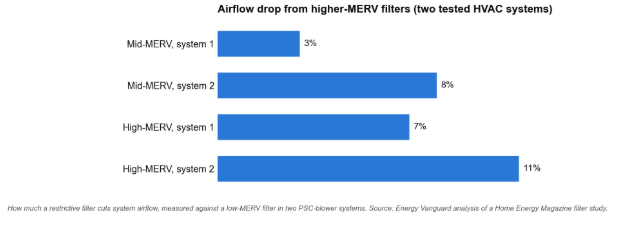
The MERV question is the one most homeowners get wrong, in both directions at once. Cheap fiberglass lets dander sail straight through, while the thickest filter on the shelf starves a system never sized for it. Testing summarized by Energy Vanguard found high MERV filters cut a system’s airflow by 7 to 11 percent against a low MERV filter. That is capacity a fur loaded system cannot spare, so the answer is more filter area, not a thinner filter.
A Clean System Outlasts The Shedding Season
None of this is glamorous, which is exactly why it gets skipped until the burner locks out on the coldest night. Whatever a search for hvac bourne ma turns up, ask that crew the questions above before they park in the driveway. The filter tells on the house. Keep it clean through the shed, get the blower wheel and ducts handled once a year, and equipment headed for scrap at year nine will still move air at year fifteen.

- Why White Silkies Are the Best Pet Chickens for Families with Kids - September 18, 2026
- Pig Feed 101: A Beginner’s Guide to Feeding Your First Pigs - September 13, 2026
- Mini Goldendoodle Puppies: The Complete Buyer’s Guide from America’s Top Designer Breeder - August 5, 2026